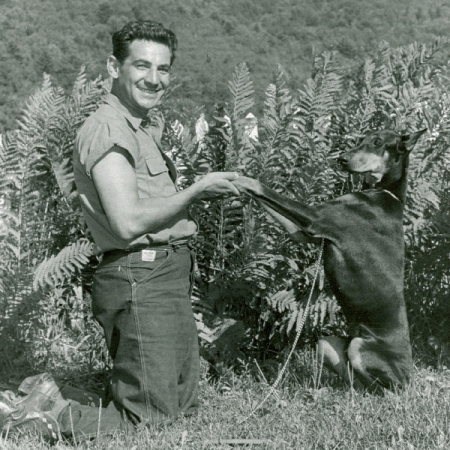
The following interview is reprinted from the Leonard Bernstein newsletter,
prelude, fugue & riffs, Fall 1994.
In 1953, WONDERFUL TOWN opened at the Winter Garden Theatre on Broadway to rave reviews. Forty-one years later,
on the eve of a new proudction of WONDERFUL TOWN at the New York City Opera, prelude, fugue & riffs visited the
show's lyricists, Betty Comden and Adolph Green, at Mr. Green's record and book-filled library overlooking
Central Park.
pf&r : How did Ruth Sherwood's stories of bohemian life in the Greenwich Village of the 1930s come to be a musical?
BC: George Abbott got together with Jerome Chodorov
and Joseph Fields to write the book of this show to be called WONDERFUL TOWN,
and they were fumbling. Mr. Abbott called me one day and said, "Do you
think you would come in and do the lyrics?" for this show. Adolph was
away -- but I contacted him and he came back. Mr. Abbott
asked "Who can you work with?" We said, "Maybe Leonard." He
said, "Go on over and ask him" and by the time we got to the door, Abbott was on
the phone.
AG: Shouting,
"Yes or no?" And much to our surprise, Leonard said yes.
BC: We were thrilled. Working with Leonard was heaven
pf&r: Mr. Abbot
sounded like a director in a hurry. How much time did you have to write the show?
AG (smiling): Four and a half
weeks.
pf&r: Film star Rosalind Russell played
Ruth in that first production. How did she enjoy the transition from
Hollywood to Broadway?
BC: She liked the score and we wrote a lot of material for
her. But she got us all together one day and said, "Listen,
Adolph. Listen, Betty. Listen, Leonard. I've got
exactly four notes in my voice and you've got to write for just those four
notes."
AG: And as for
the structure, she said, "It should be those four notes, made up of
da-da-da-da-joke, da-da-da-da-joke."
BC: We did not have this song when we opened in New Haven. Then Rosalind had a bad throat and was in bed.
pf&r : Was the condition of her throat related to the absence of the opening number?
BC:
(laughs) No, she was not that kind of woman. Adolph and I and Lenny met and we wrote this new number, "100 Easy Ways to Lose a Man." Then we wheeled the piano down the hallway in the hotel.
AG: In front of her bedroom.
BC: We could play it for her form the hall, yelling the song into her room. That's how she first heard it.
pf&r: And of
course "100 Easy Ways to Lose a Man" became the show-stopper. WONDERFUL
TOWN was a hit, eventually winning four Tony Awards, including Best
Musical. What was opening night like?
BC: After the opening there was this
big party at the home of Josh and Nedda Logan. We were all up there and we were nervous, because you're never sure. You never know what on earth the reviews are going to say.
AG: Then came those triumphant notices. As a matter of fact, it was Marlene Dietrich who ran down to Times Square to bring back the notices.
pf&r: How do you feel WONDERFUL TOWN has
held up over 41 years? Does it still speak to today's audiences?
AG: You bet!
pf&r: Why did you set the time in the
1930s instead of the 1950s, when the musical was being written?
BC : Lenny went to the piano and started to play a vamp used by Eddie Duchin, the great orchestra leader and pianist of the Thirties.
AG: As soon as Lenny started playing that, we felt inspired.
BC:
We knew that the show would have a style and be rooted in that period. It
would have a conga, there would be swing, the would be jazz. With all
kinds of wonderful music to work with, we felt at home. WONDERFUL TOWN's
overture starts with that vamp.
AG: We think
City Opera's WONDERFUL TOWN will be a terrific production.
BC : We are just heartbroken that Leonard's not here!