Latest News
Bernstein at the Vanguard
Posted September 21, 2026
Bernstein at the Vanguard
by Philip Clark
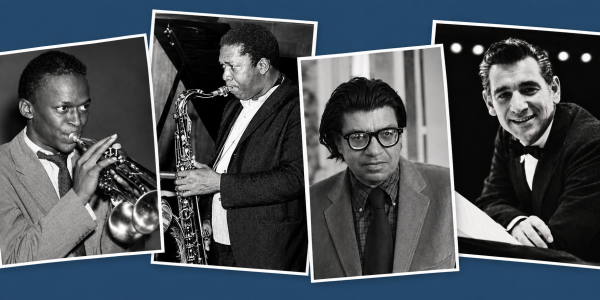
Leonard Bernstein was already eight years old in 1926, and only a couple of years away from his fateful meeting with Aunt Clara’s piano. That was the year Miles Davis, John Coltrane, and Morton Feldman were all born, and it says much about Bernstein’s stylistic reach that they were all destined to cross paths in New York City, and that celebrating their centenaries becomes possible through their encounters with Bernstein.
Miles Davis, who grew up in St. Louis, enrolled in 1944 at the Juilliard School of Music under the pretence of studying classical music, to satisfy his mother, while his motivation was actually to find Charlie Parker and Dizzy Gillespie and immerse himself in bebop. Coltrane, after his military service, returned to his hometown of Philadelphia, until the call came to join Miles Davis’s quintet in 1955, after which he gravitated increasingly towards New York.
Bernstein had moved to the city in 1941 after graduating from the Curtis Institute of Music, while Feldman, that jazz-loving man about town, with a rapier Larry David wit and revolutionary ideas about music of his own, would no doubt have stumbled into the jazz clubs where Miles and Coltrane worked; perhaps even into the Village Vanguard, then a fledgling jazz club, where a satirical cabaret troupe called The Revuers – Betty Comden, Adolph Green, and Judy Holliday, with a young Leonard Bernstein occasionally sitting in on piano – had secured a regular gig.
Lines of connection between the four cross identifiably for the first time on the evening of September 10, 1956, when Bernstein and Davis walked into Columbia Records’ 30th Street Studio to work together on a version of the Victor Young standard “Sweet Sue, Just You.” This was not, as is often assumed, music for Bernstein’s Omnibus television programme The World of Jazz, which had been broadcast in 1955 (when the composition that named this newsletter had its first performance), but for a follow-up LP designed to explain jazz to the uninitiated, What Is Jazz?, released in 1956. Bernstein utilised “Sweet Sue” – a song, as he explained, everyone knew – to trace jazz’s stylistic evolution. Included were versions from the Columbia archives by Bessie Smith and Louis Armstrong, while former Count Basie trumpeter Buck Clayton illustrated Bernstein’s points in the studio by leading a distinguished group of musicians, including tenor saxophonist Coleman Hawkins – and then the Miles Davis Quintet represented modern jazz.
Miles – alongside Dave Brubeck and Johnny Mathis – had been Columbia’s popular music head honcho George Avakian’s recent star signings to his label, and the idea of bringing Lenny and Miles together in the studio no doubt appealed greatly. Bernstein came to one of the sessions that produced Miles’ first Columbia record, ‘Round About Midnight, and studio chat between the two men surfaced when Sony issued Miles Davis and John Coltrane: The Complete Columbia Recordings, 1955-1961 in 2000. To hear their familiar voices together, Davis’s rasp and Bernstein’s perfectly formed vowels, gives quite the thrill, especially as they sound elated to be in each other’s company.
Bernstein, on a mission to procure a track for his educational LP, sings what he’d like to hear, and with immaculate jazz-swing timing. He asks the group to try the intro (as arranged by Teo Macero), making sure that they play the two pick-up notes of the melody – “just so people know you’re playing ‘Sweet Sue’” – but then they can “forget about the tune.” It’s agreed Miles, Coltrane, and pianist Red Garland will improvise a chorus each, then Davis says “Trane and I will play one [chorus] together, out.” Miles’ swaggering improvised lines also manage to be lean and mean; Coltrane’s solo chisels away at the harmonies like a sculptor chipping at stone. The session was joy-filled, the studio talk punctuated with laughter.
The circumstances around Bernstein’s encounter with Feldman were considerably more fraught, although none of it was Feldman’s fault. Bernstein and the New York Philharmonic’s recording of Feldman’s “Out of ‘Last Pieces’”, at the Manhattan Center, on February 11, 1964, took place a few days after now-notorious performances at Philharmonic Hall during Bernstein’s ‘The Avant-Garde’ season. Following a first half of music from Vivaldi’s Four Seasons and Tchaikovsky’s Pathétique Symphony, Bernstein opened after the interval by improvising freely with the Philharmonic, before playing the Feldman and music by John Cage (Atlas Eclipticalis) and Earle Brown (Available Forms I).
Cage’s piece provoked a scandal. Realising that Cage’s chance procedures would fade their contact microphones on and off, rendering their painstakingly prepared individual parts inaudible, the orchestral players rebelled, and Bernstein delivered a headmasterly rebuke the next day. Cage became the story, and Feldman’s rather beautiful piece has too often been overlooked. As Feldman explained in the Philharmonic playbill, his composition ideal was that “sound in itself can be a totally plastic phenomenon, suggesting its own shape, design and poetic metaphor” beyond the emotional swells of music. To that end “Out of ‘Last Pieces’” was designed around a graphic notation – notes in boxes, rather than hanging on staves – of his own invention.
In his studio recording, Bernstein felt the poetry at the core of Feldman’s piece. Its taut construct, like Webern, opened into a jewel box of finespun glittering metal pitched percussion set against ribbons of pianistic interjections (played by none other than David Tudor), while wind clusters floated by like ever-morphing cloud forms. As Bernstein had explained during his introduction to Atlas Eclipticalis at Philharmonic Hall, he felt a “duty” to keep New York audiences abreast of the latest trends in composition, like Cage’s; but you feel him genuinely luxuriating in Feldman’s colours and textures. True enough, it’s likely that he felt greater stylistic kinship with Miles transforming popular song; then again, Bernstein scores like Kaddish and MASS clearly owed something to his diligent and thoughtful engagement with the New York avant-garde, always keeping an open ear.
A postscript: in April 1958, Bill Evans replaced Red Garland in Miles Davis’s group. A few months before he played on Davis’s historic Kind of Blue record, Evans recorded Bernstein’s song “Some Other Time” from On the Town on his own trio album, Everybody Digs Bill Evans. Doing so, he became fixated on the pair of oscillating chords with which Bernstein introduced his tune. With the session now over, and alone in the studio, he rocked those two chords backwards and forwards at the piano. His trio’s version of “Some Other Time” was dropped from the final album (although restored in reissued versions) in favour of those post-session afterthoughts. Evans transformed Bernstein’s base harmonic alchemy into a scrollwork of overlapping tonalities, with accents criss-crossing. A strategically placed tritone tipped the music into ever a deepening kaleidoscope of polytonal harmonies. He called his invention “Peace Piece” and this is the track anyone seeking the essence of Bill Evans needs to hear – Bernstein’s imprint lingering long after the studio door had closed.
--
Philip Clark, author of Dave Brubeck: A Life in Time, is a UK-based music and culture journalist who currently writes for New York Review of Books, Prospect, The Spectator, and The Wire. He trained as a composer but has recently preferred to produce sounds of his own, playing piano as part of a weekly free improvisation collective. He has also worked with the legendary guitarist of The Kinks, Dave Davies, on the latter's autobiography, Living On A Thin Line.
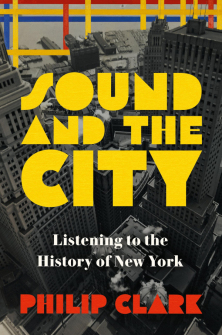
His next book, Sound and the City: Listening to the History of New York, is a sweeping history of New York City told through its music and sound, exploring how the city’s landscape, architecture, politics, and diverse communities have shaped its musical identity from the Ice Age to the present. The book will be published next April by Hachette.
>https://www.hachettebookgroup.com/titles/philip-clark/sound-and-the-city/9780306826993/