Latest News
The Maestro's Mailbox
Posted October 21, 2026
The Maestro’s Mailbox
by Kate Guthrie
Everyone’s knowledge has its limits. Discovering a gap in one’s knowledge, however, can be embarrassing – particularly when one is in a position of authority. It was perhaps to ease such embarrassment that Rachel Orris wrote to Bernstein in the winter of 1961:
Jan 18, 1961
Dear Mr. Bernstein,
The Friday Morning Musicale of which I am program director for 61-62 has been reviewing your delightful work ‘The Joy of Music’ … My main reason for writing you is to settle the confusion about the pronunciation of your name. […] Your treatment of the St. Matthew Passion is great and I heartily agree, but I am interested to know if your religion is Jewish or Christian. If you do not choose to say I shall understand, but as a Christian I have never heard a better sermon preached about Christ...
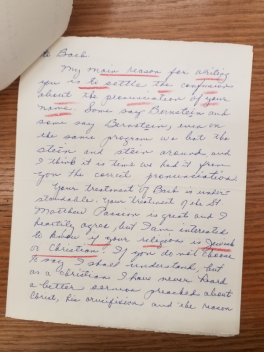
The situation had felt awkward. Orris had been trying to lead a discussion of Bernstein’s book, but conversation had been side-tracked by a debate over how to pronounce his name. This diversion was frustrating because it had undermined a prime opportunity to further the club’s civic improvement mission. The discussion of Bach in her chosen text resonated more deeply with the club’s mission than the readings that were usually chosen. Then another question occurred to her: was Bernstein a Christian?
Rachel was far from the only person who wrote to Bernstein in the hope of discovering more about him. “I wondered if you would express your feelings about the philosophy of life itself,” another correspondent asked. “When did you learn all about music?” enquired a third. “How did you become famous?” “Does your success make you feel dizzy?” “The photograph is delightful … do you actually look that nice?
Bernstein’s archive contains thousands of such enquiries. Usually written by strangers, these letters are filed separately from the rest of his correspondence – as “fan mail.” It is a part of the collection that music historians and critics often ignore.
Questions such as “is your religion Christian” can seem almost comically uninformed. Robert Shafran, who spent his childhood in Cleveland and whose wife wrote to Bernstein around the same time as Rachel, recalled in a recent interview: “Oh, everybody knew that Leonard Bernstein was Jewish.”
Bernstein himself, however, did not treat such questions as laughable. Unlike the scholars who have shown little interest in his fan writers, he took their letters seriously – so seriously that his daughter Jamie Bernstein him regularly sitting down to read them. Every week, she recalls, Bernstein’s personal secretary Helen Coates “would walk across to our side of the building and go up to apartment 4B where we were. And she would sit with my father. She would always refer to it as ‘having him.’ ‘Can I have you at 2 p.m. on Tuesday?’ And they would they would sit down together and go through all the mail. And that would mean going through the fan mail in addition to anything else that was coming up in the mail. And then she and my father would devise how to respond to the email.”
The archive provides further evidence of this careful engagement. Almost every fan letter was annotated by Coates, who recorded whether an answer had been sent and, if so, when. She also noted where additional materials – autographs, signed photos, or biographical information – were enclosed.
Occasionally, her annotations reveal something more of the work involved. One letter came from a “collector of autographed pictures of noted Opera stars.” Coates drafted the response:
Since Mr. L.B. is not an Opera star, but rather a conductor, composer, and pianist, he does not seem to fit into your collection of autographs of ‘noted Opera stars’. You have evidently confused Mr. B. with another artist.
This exchange is slightly comic, but it demonstrates how much importance Bernstein and Coates placed on his public relations. Fan mail was never simply discarded. It was read carefully and answered fully – even when Bernstein had been confused with someone else.
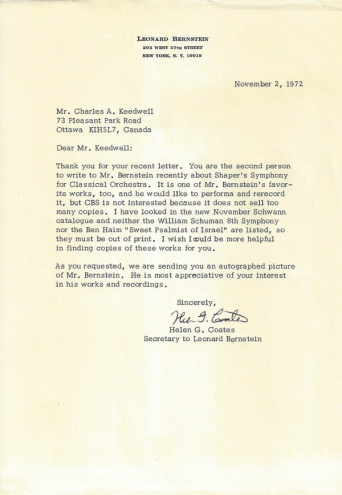
Carbon copies of the final replies were not saved, but one has recently come to light in a collection of family memorabilia. It was sent in response to a long letter that Canadian fan Charles Keedwell wrote in October 1972. Coates had not only organized the autographed picture that Keedwell had requested. She had also searched the Schwann record catalogue so that she could give an accurate answer to his questions about worn-out records he wanted to replace.
***
What might we learn from Bernstein’s inclination that his fans were worth engaging with? Over the past five years, I have been trying to answer that question. I have read hundreds of the letters he received. I have also tracked down a much smaller number of fans who wrote to him in the 1960s – or their descendants – and interviewed them, seeking to understand what their fan letters meant to them. Most had forgotten that they had even written to him. Yet all had powerful stories to share about the positive impact that Bernstein had made on their life – not just when they wrote, but in the decades that followed.
Studying these letters has required me to approach them differently from conventional historical sources. Their value as factual records in the traditional sense is limited. They are more intimate, more personal. They communicate feelings more strongly than facts.
Rather than dismiss Rachel’s questions as amateur ignorance, we can look to them as a reminder that information was far less accessible in the 1960s than it is our internet era. More importantly, her letter also reveals the crucial role that creative fantasies played in fuelling Bernstein’s fan base. Rachel speculated that she might share a Christian understanding with the maestro, which would make his book yet more meaningful. Robert Shafran’s Jewish community felt a connection on account of his Jewishness. Keedwell who had given up on a promising musical career to earn a more reliable income for his family, approached Bernstein as a fellow musician and specialist.
Bernstein’s appeal was not just down to his musical genius – exceptional though it was. It also depended on his fans’ abilities to imagine a meaningful connection to him. In their letters, they transformed a distant public figure into someone who could, in some sense, belong in their own lives.
--
Kate Guthrie is a Senior Lecturer in Music at the University of Bristol. She is the author of The Art of Appreciation: Music and Middlebrow Culture in Modern Britain (University of California Press, 2021) and "Bernstein's Fans" (Journal of the American Musicological Society, 2026), among other things.