Latest News
Still Standing, Still Legendary: Revisiting Carnegie Hall's Concert of the Century
Posted April 21, 2026
Still Standing, Still Legendary: Revisiting Carnegie Hall's Concert of the Century
By Kathleen Sabogal
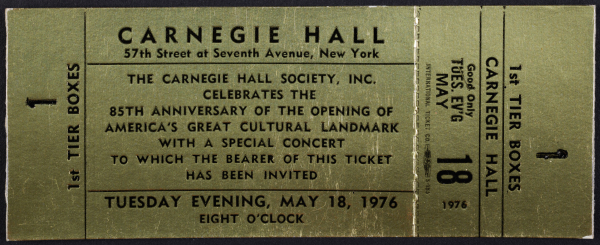
Photo: Ticket for Carnegie Hall's 85th Anniversary Concert, May 18, 1976. Courtesy of the Carnegie Hall Rose Archives.
On May 18, 1976, Carnegie Hall celebrated the 85th anniversary of its 1891 opening, with a performance dubbed the Concert of the Century by the Hall’s executive director Julius Bloom. The star-studded lineup included Leonard Bernstein, Yehudi Menuhin, Isaac Stern, Dietrich Fischer-Dieskau, Mstislav Rostropovich, Vladimir Horowitz, the New York Philharmonic, and the Oratorio Society of New York conducted by Lyndon Woodside. But this was not solely a birthday celebration. It also marked the launch of the first national endowment fund for Carnegie Hall—created to raise $6.5 million (roughly $37 million today) to secure the Hall’s future. With New York City teetering on the edge of bankruptcy just a year earlier, the timing was bold, but necessary.
The Carnegie Hall Corporation had run the building successfully since 1960 without any large-scale fundraising campaigns, but growing economic pressures made that model unsustainable. The Hall’s leadership — led by president and violinist Isaac Stern, who had fought to save Carnegie Hall from demolition in 1960—determined that a permanent endowment was essential. Stern called on some of the most revered musicians of the day, including his close friend Bernstein, to help secure the future of his beloved Hall by participating in this special event.
Bernstein’s presence that evening carried immense historical weight. His Carnegie Hall debut on November 14, 1943, with the New York Philharmonic—stepping in for an ailing Bruno Walter—had launched his career and became a foundational story of American classical music. His bond with the Hall was deeply personal, starting as a rehearsal pianist in the upstairs studios (where he met Jerome Robbins) and then living in one of those studios when he made that famous debut. By his final concert at Carnegie Hall in 1990 with the Vienna Philharmonic Orchestra, his total number of appearances exceeded 400, including the 1986 concert celebrating the reopening of the Hall after its restoration, where he conducted the world premiere of his Opening Prayer—the very first work commissioned by Carnegie Hall.
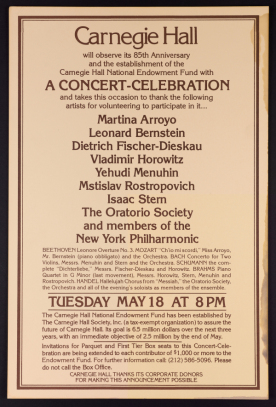
Photo: Carnegie Hall 85th Anniversary Celebration, 1976. Courtesy of the Carnegie Hall Rose Archives.
Bernstein opened the 1976 Concert of the Century conducting members of the New York Philharmonic in Beethoven’s Leonore Overture No. 3. The choice was a deliberate act of historical remembrance; it was one of the pieces performed on Carnegie Hall’s opening night in 1891. In addition, Bernstein also played harpsichord while conducting J. S. Bach’s Concerto for Two Violins with Menuhin and Stern.
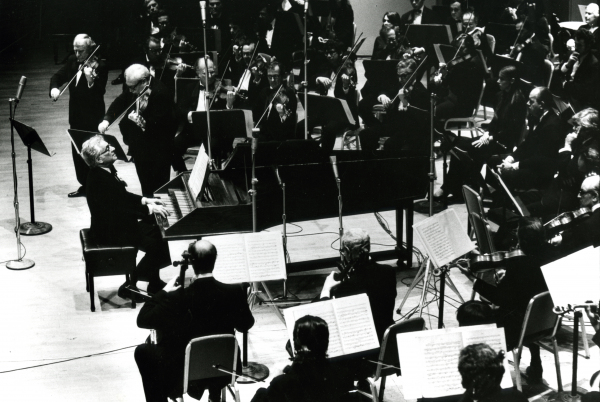
Photo: Yehudi Menuhin, Isaac Stern, Leonard Bernstein, and the New York Philharmonic performing at Carnegie Hall's 85th anniversary concert, May 18, 1976. Photo by Gjon Mili for Life Magazine © Time Inc.
Horowitz was another major draw, appearing not in his customary role as solo recitalist, but as a collaborator. He accompanied Fischer-Dieskau in Schumann’s Dichterliebe—described by one critic as “the occasion of a lifetime” — and joined Rostropovich for the Andante from Rachmaninoff’s Cello Sonata and the first movement of Tchaikovsky’sPiano Trio with Stern and Rostropovich.
The presence of the Oratorio Society of New York gave the evening an added layer of historical resonance. Carnegie Hall had been originally conceived as a home for the ensemble—during the Hall’s opening week in 1891, Tchaikovsky himself conducted the ensemble in the US premiere of his Pater Noster. Eighty-five years later, the group performed it again on the same stage.
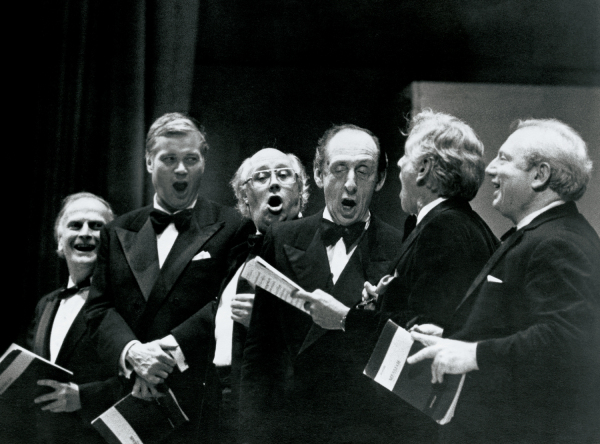
Photo: Dietrich Fischer-Dieskau, Isaac Stern, Leonard Bernstein, Mstislav Rostropovich, Vladimir Horowitz, and Yehudi Menuhin singing at the Concert of the Century, May 18, 1976. Courtesy of the Carnegie Hall Rose Archives.
The concert reached its emotional peak with the “Hallelujah” Chorus from Handel’s Messiah, when all the star performers—Bernstein, Horowitz, Stern, Menuhin, Rostropovich, and Fischer-Dieskau—joined the Oratorio Society on stage to sing together. It was a moment that transcended performance, celebrating not just an anniversary but the survival of the Hall itself. By the end of the evening, Carnegie Hall had raised $1.2 million toward the endowment fund—nearly $7 million today.
The concert was recorded live by Columbia Records and released as a two-record album. In 1978, it won the Grammy for Best Classical Album, and all the artists donated their royalties to the endowment fund.
The Concert of the Century was more than a performance. By bringing together the charisma of Bernstein and the dedication of Stern, Carnegie Hall transformed a birthday celebration into a foundation for its future. The Carnegie Hall National Endowment Fund marked the end of an era of uncertainty and the beginning of a modern nonprofit model of cultural stewardship that endures to this very day.
On May 5, 2026—135 years after its opening— Carnegie Hall marks the 50th anniversary of that legendary night with another extraordinary gathering that includes Emanuel Ax, Joyce DiDonato, Michael Feinstein, Renée Fleming, Evgeny Kissin, Lang Lang, Isabel Leonard, Audra McDonald, Yannick Nézet-Séguin, Daniil Trifonov, the NYO-USA All-Stars, the Oratorio Society of New York, and more. The Overture and “Make Our Garden Grow”, both from Bernstein’s Candide, will be featured on the program. More Info/Tickets
The 1976 concert proved that music, at its most powerful, can do more than move an audience—it can save an institution. As Carnegie Hall marks the 50th anniversary of that remarkable night, the Concert of the Century stands as proof that when artists give everything to a cause in which they believe, the results can echo for generations.
Kathleen Sabogal is the Director of the Carnegie Hall Rose Archives and Museum.