Latest News
Songfest at 50: a Personal History
Posted May 18, 2026

Songfest at 50: a Personal History
By Leonard Slatkin
Fate can play cruel tricks on us. Once in a while we are blessed with a creative miracle, only to be sent back to harsh reality. Destiny seems to have played a wicked part in turning Songfest on its head, at least as regards the nation’s capital.
You would not think that a piece of music could evoke this feeling, but as I came to understand the journey of Leonard Bernstein’s remarkable song cycle, it became clear that its creation is now intertwined with current events in our Washington, D.C.
Written over a two-year span, Songfest is a love letter to the country, while at the same time being a cautionary tale. I have come to think of it as the composer’s most autobiographical work, with its evocation of society’s difficult struggles. The same battles written about by the poets are also the same aches and pains that Bernstein fought his whole life. Whether dealing with ethnicity, sexuality, civil discourse or racial unrest, these twelve songs – and thirteen poems – encompass a vast range of emotion and complexity.
It is striking that for almost ten years, there were very few major works from the composer’s pen. After MASS, which opened the Kennedy Center in 1971, there really was not much until this composition, which had its full premiere in 1977. That performance was also at the KC with the National Symphony Orchestra.
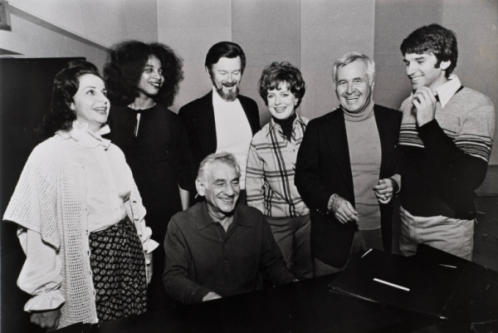
Photo: Songfest, 1977. Leonard Bernstein with Rosalind Elias, Clamma Dale, John Reardon, Nancy Williams, Donald Gramm, and Neil Rosenshein. Avery Fisher Hall, NY. Photo by Richard Baarten, courtesy of the New York Philharmonic Shelby White & Leon Levy Digital Archives.
At first hearing, I was confused by the work. The choice of texts seemed odd, as they did not appear to relate to each other. Likewise for the music. Right from the first few bars it was evident who wrote the music, but what kind of piece was this? Six singers, three sextets, a solo for each, and a couple of duets and trios thrown in as well. It all seemed out of whack.
Were we supposed to listen to it as a unified whole or simply a series of songs? There was no question that the eclecticism of musical styles suited Bernstein to a tee. He was comfortable in the jazz idiom as well as twelve-tone, Stravinskyism, and simplicity. The answer to the question wound up, at least for me, to be that both were true.
That is the approach I have taken in my various performances of the work as well as a recording. I remember Bernstein telling me that although he might not have agreed with my musical choices sometimes, he understood how I had arrived at various conclusions. It was as if he realized that if his concert music was to survive, it would have to undergo the same kinds of transformations that he applied as a conductor, to other composers.
So here we are at the fiftieth anniversary of the work and the two-hundred and fiftieth of the the Declaration of Independence. If Songfest is meant to be a celebration of the country, where is this work today? Perhaps it has been forgotten in terms of the connection to our nation’s history. Maybe it’s still an enigma for some. Plus, it is not easy. You need six terrific singers and have to hope that none of them get sick on the days of performance.
As we seek the good in our land, perhaps this piece can convey that message. It addresses our current difficulties through the lens of the past. It offers solace and hope but tempered with reality. Songfest also reminds us that diversity and creativity go hand in hand, something that the current administration of our government seems to have consigned to oblivion.
In an astonishing coincidence, the very spot where the initial performances of Songfest occurred is about to be dismantled. And along with it, we are inching ever closer to the liquidation of the National Symphony Orchestra. Leonard Bernstein had developed a wonderful rapport with these musicians, performing with them often. He knew his place not only in the cultural pantheon but also on the national scene. What better way to celebrate his country than in its capital? Perhaps as a final gesture, the NSO might consider revisiting this piece, playing it as their farewell and hoping for a brighter future.
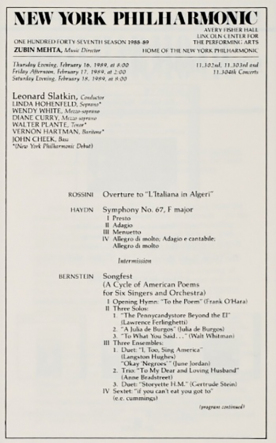
On a personal note, I had the opportunity to perform Songfest with the New York Philharmonic in February of 1989. Bernstein had hoped to attend, but sadly, could not. Before the Friday afternoon presentation, the phone in my dressing room rang. It was the Maestro himself, struggling to speak through his coughing fits. His good wishes for our efforts were among the most heartfelt I have ever heard. He died a year and a half later, when I was also at the helm with the Phil.
Songfest lives through its poetry and music, and Leonard Bernstein lives inside all of us through his humanity, artistry and talent. Let’s hope this work is seen as one of the beacons that lead us into our next 250 years.
Or, as Poe wrote in the final song, "Israfel":
Yes, Heaven is thine; but this
Is a world of sweets and sours;
Our flowers are merely -- flowers,
And the shadow of thy perfect bliss
Is the sunshine of ours.