Latest News
An American Voice by John Adams
Posted June 15, 2026
An American Voice
by John Adams
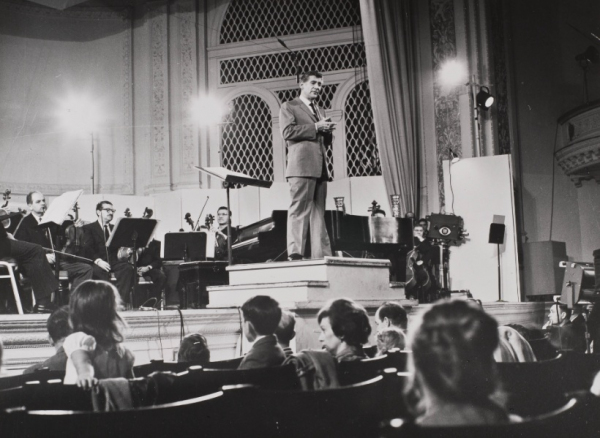
Photo: Leonard Bernstein giving a Young People's Concert. Courtesy of the New York Philharmonic Shelby White & Leon Levy Digital Archives.
I first heard the name Leonard Bernstein some time in the late fifties, when I was not yet a teenager. It was in a conversation between my parents about an open rehearsal they’d attended at Tanglewood some fifteen years earlier. My mother had been enthralled by this young conductor’s evident charisma, his good looks, his innate musicality, and his uninhibited podium gyrations. My father, skeptical Yankee that he was (he could never stomach even FDR) had remained a doubter, suspicious of showmanship at perhaps a little alarmed at the thought of a local Massachusetts boy with a pompadour at the helm of New England’s most revered cultural institution.
Not long after, I began listening, on a small table-model AM radio in my bedroom, to live broadcasts of Bernstein’s first seasons as Music Director of the New York Philharmonic. I recall in sharp clarity an afternoon broadcast of a piece called “The Right of Spring,” or so I thought was the title. It was my first dose of modern music, and I remember how strange the harmonies and sonorities sounded coming over that tiny, crackling radio. The broadcast included Bernstein speaking to the audience before conducting the music. That was a shock, because classical music up to this point had been the province of mysterious, remote foreign-born “maestros.” These were unknowable, almost alien, frequently tyrannical authority figures, crystallized in the public’s mind by iconic images of Toscanini, Stokowski, or Fritz Reiner on record jackets and program books. These forbidding “maestros” certainly never would chat with their audience, least of all in the relaxed, familiar style of this young, handsome, and brainy upstart. It was a shock and a delight, then, to turn on the radio and hear the voice of an American speaking in the common vernacular, but with vivid images of the music of such daring and radical composers as Igor Stravinsky and Charles Ives. And then I saw on a magazine cover the face that went with this charming voice—Bernstein’s face—and I thought “this guy looks more like James Dean than he looks like Toscanini.”
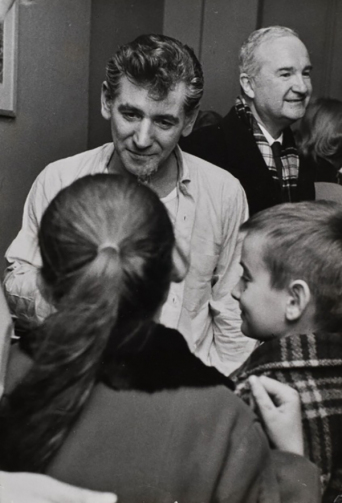
Photo: Young fans flocked to a new-style conductor who could discuss Beethoven or the Beatles with equal ease. David Keiser, New York Philharmonic President, is in the background.
My parents were adamantly opposed to having a television, so I went to a friend’s house to watch my first Young People’s Concert. That was a revelation. I was riveted to the television screen as “Lenny” talked about everything from Beethoven’s Fifth to Stravinsky to jazz. I took every opportunity to see as many of these telecasts as I possibly could. For me they were a vindication. Growing up in rural New Hampshire and having a passionate interest in classical music, I’d had to weather much ridicule and contempt from other boys who thought this was the stuff of sissies. Bernstein put the lie to all that; he was like a movie star, only better. Grand looking and fully at ease in the glare of the television lights, he was also persuasive and articulate about the music that I loved, and he had a way of making listening to Beethoven or Stravinsky exciting and even cool.
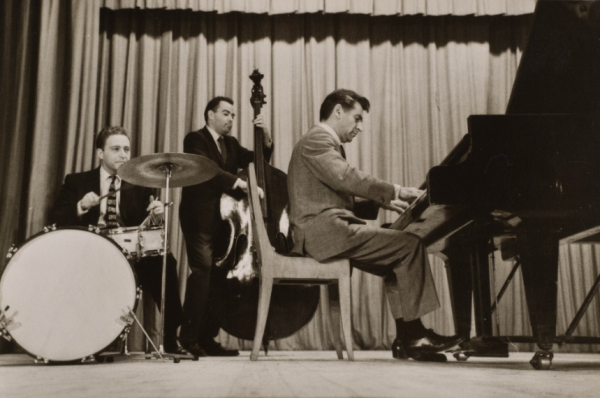
Photo: In an impromptu jazz performance at a 1959 Moscow party given for the Philharmonic by the Soviet Minister of Culture, Bernstein, joined by drummer Morris Lang and bassist Robert Gladstone, was prompted by what he called "a last-minute inspiration—I haven't played jazz for years." Photo by Patricia Judd.
An American Icon
Lenny had the perfect pedigree for an American cultural icon, having been highly educated in European classics of music and literature while at the same time being thoroughly at home with American popular culture. He’d already written some of the finest show tunes in the history of Broadway; he knew his jazz and could event sit down at a moment’s notice and improvise on a bop tune; he was able to cite a Beatles’ song in a discussion of musical form; and, a serious composer of concert music himself, he was a crusader for establishing a new American symphonic repertoire. By the time Philharmonic Hall opened in 1962, his was quite possibly the most glamorous profile in the country outside of those of the Kennedys and Elizabeth Taylor. He had appropriated the archetypical mystique and persona of the “famous conductor” and Americanized it, countering the classic image of the beady-eyed, long-haired, and omniscient conductor with the image of a regular guy, hip but sophisticated, convivial but capable of great seriousness. Like the urban American he used as a backdrop for his best stage works, he was all nervous energy, enthusiasm, and constant industry, able to do Beethoven one minute and then turn around and converse with kids or sit in on a jam session the next. I loved it, and even though at an early age I was already able to detect something a bit hasty and rough about his performances, I thought I’d found the model for what the future of classical music in America would be.
High and Low Culture
We Americans want our cultural leaders to be simultaneously high- and low-brow. Since the days of Mark Twain, and even before, we have conflated “intellectual” with “elite.” Unless you are a college professor, comfortably resigned to a small circle of like-minded scholars, you must hide your loftier sentiments and conceal your hunger for the depth that great art provides. Everyone must adore Elvis. Bernstein’s great gift was that he could operate with total ease and naturalness in both worlds, that of high art and that of American “popular” culture. No one since has quite been able to straddle the two worlds with such ease, although many have tried.
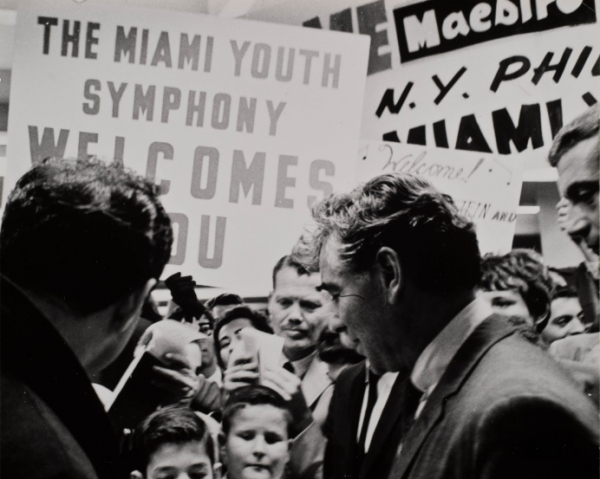
Photo: Wherever he went, Americans embraced Bernstein as one of their own. During the Philharmonic's 1963 U.S. tour, young fans turned out in droves to greet the Orchestra at the airport.
When I ponder the dizzying whirl of activity that characterizes Bernstein’s years with the New York Philharmonic, I am struck by the astonishing powers of imagination he brought to the post. The Young People’s Concerts not only made him a nationally recognized media star, they also launched a whole generation’s enthrallment with good music, and I count myself as one of his successes. Bernstein was not a strict disciplinarian like Szell or Reiner, who would laboriously hone an orchestra over time into a laser-sharp, finely tuned ensemble with hair-trigger sensibilities. Instead he used his bully pulpit to educate and to advocate. We remember him most for his missionary zeal on behalf of the music of his own countrymen and of course in his devotion to the music of Mahler, whose work he elevated to a much wider public consciousness. It boggles the mind to realize that as recently as 1960 Mahler was a rarity on orchestral programs in the United States. Bruno Walter had been Mahler’s apostle to the New World, making famous recordings of five of the nine complete symphonies, most of them with the New York Philharmonic. But the larger of Mahler’s symphonies—the Third, Sixth, Seventh, Eighth, and Ninth—almost never appeared on the programs of American orchestras until Bernstein took them up and made them standard fare. Through him Mahler came to the forefront of our awareness and finally reached his rightful status as one of the greatest composers of all time. This triumph was already accomplished before Bernstein left New York in the 1970s to focus his activities in Vienna and elsewhere in Europe.
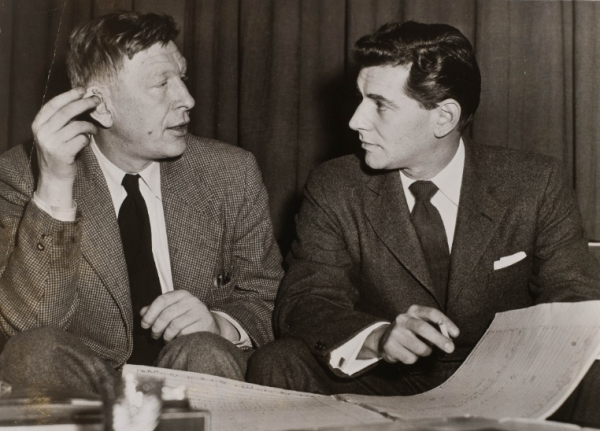
Photo: With W.H. Auden, whose poem "The Age of Anxiety" inspired Bernstein's Symphony No. 2, which was premiered in 1949 by the Boston Symphony Orchestra. Photo by Ben Greenhaus.
Bernstein also brought Charles Ives’ music out of its decades of obscurity and made of Ives, if not the proverbial household name, at least the acknowledged “grandfather” of American classical music. Bernstein’s recording of the Second Symphony was a memorable event for all of us composers who were searching for a lost patrimony. (This lifting of Ives out of obscurity and into iconic status was much aided by Columbia Records, whose corny Americana imagery accompanied every new release.) Ives, formerly the province of a small band of new-music cognoscenti, was suddenly proclaimed, by Bernstein at a 1958 Philharmonic Preview concert, “our Washington, Jefferson, and Lincoln of music.”
Paradoxically, the Ives that Bernstein was drawn to was the conservative Dvořák-tinged folksong symphonist of the Second Symphony. Bernstein left it to others, particularly his protégé Michael Tilson Thomas, to discover and champion the truly radical and experimental music of Ives’ maturity. I doubt it was timidity on Bernstein’s part not to tackle the really gnarly later Ives pieces. I suspect more that he simply had a natural aversion to music that was hypercomplex or aggressively dissonant.
Likewise, Bernstein had brief encounters with Milton Babbitt, the Yoda of American academic serialism, and with another not easily accessible master, Elliot Carter. Bernstein conducted Babbitt’s punishingly difficult Relata II for orchestra on four concerts in January of 1969. He never programmed that piece or any other Babbitt music thereafter. He did the music of John Cage once on subscription concerts in 1964. That piece was Atlas Eclipticalis, a work in which the pitches, durations, and dynamics are all determined by placing a map of the stars on music staff paper. It asks the conductor not to conduct but rather to be a human stopwatch. Is there a long-lost film of Lenny’s performance of Atlas Eclipticalis? Probably not, but it would be fun to see if it exists and see how the normally hyper-expressive Bernstein dealt with momentarily having to become an automaton.
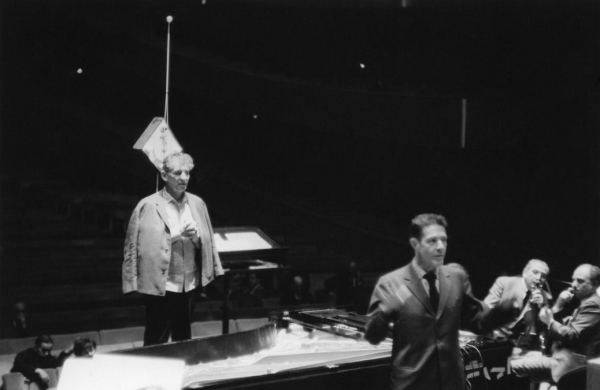
Photo: Composer John Cage explains how to fit the orchestra's "notes" or "cancellations" to the cycle of the baton seen behind Bernstein for the performance of Atlas Eclipticalis in February 1964, during the Philharmonic's Avant-Garde series of concerts. Looking on a Concertmaster John Corigliano and Frank Gullino, violin. Photo by Bert Bial.
In 1970, Bernstein gave the world premiere of the one and only Carter piece he ever conducted during his long tenure with the Orchestra, the dense and rhythmically multi-layered Concerto for Orchestra, which had been commissioned by the Philharmonic. Carter’s music, with its pungent dissonances, irregular rhythmic groupings, and constantly dislocating pulsations, seems to summon up the fault line between Lenny’s more native-born populist proclivities and the then-current European high modernism (a style that fit the sensibilities of his successor, Pierre Boulez, to a T).
Clearly Bernstein’s curiosity and open-mindedness would prod him to try something at least once. A little-known fact: The world premiere of Olivier Messiaen’s mammoth Turangalîla-Symphonie, one of the few undisputed additions to the orchestral canon from the latter part of the twentieth century, was given in 1949 by the Boston Symphony Orchestra, conducted by a thirty-one-year-old Leonard Bernstein.
When it came to atonality and rhythmically disjunctive music, Bernstein could not overcome a deep-seated antipathy, an almost gut reaction against it. And his programming reflected that. Aaron Copland’s music appears on Philharmonic concerts two hundred forty-three times. Roy Harris and William Schuman, two other American “populists” whose music in the intervening years has suffered a decline in interest, were also frequent choices for Bernstein programs (Harris for eighty-four performances and Schuman for eighty-one). But Roger Sessions, an equally respect member of the same thirties generation, but a more “difficult” composer of densely argued expression, barely made a showing on Philharmonic concerts.
Battling Atonality
After his retirement as Music Director, Bernstein, with the help of his readings of Noam Chomsky’s theories of structural linguistics, would use his Norton Lectures at Harvard to try and explain his feelings about the crisis in contemporary music, and why his intuition told him that tonality and pulsation were essential to the musical experience.
For all his native intelligence and astonishing mental powers, Bernstein was fundamentally a musician from whom Eros was a prime mover. Bernstein doubtless couldn’t find the erotic potential in the music of Schoenberg or Carter, and, the music leaving him cold and untouched, he could not bring himself to go near it again, not even as a collegial gesture of support for a fellow composer.
You could see Eros not only in the way his small, compact, and lithe body moved in sync with what he was conducting, but also in the very nature of his own music, which, not in the least troubled by modesty, he programmed with the Philharmonic no fewer than one hundred seventy-five time—second only to Copland among American composers. Bernstein the composer is at his best when the music is choreographic and suffused with sensuality. West Side Story is, to my mind, by far and away his masterpiece. None of the “serious” symphonic works can come near it for spontaneity, verve, sheer sexual energy, and the power to move the listener emotionally and physically. Bernstein’s weightier, more philosophical symphonies seem barely able to support their own emotion, and come alive only when they burst out into dance or some kind of rhythmically impelled physical expression. As a composer, Bernstein did not move comfortably back and forth over the continuum between solemnity and joy. In The Age of Anxiety, only the fleet, balletic evanescence of the “Masque” movement transports you into the realm of pure, uncluttered pleasure.
With the composers he could relate to, and especially with this esteem Aaron Copland, Bernstein was generous and enthusiastic in his advocacy. By the time Bernstein ascended to the music directorship of the Philharmonic, Copland was already well established as America’s most honored “classical” composer, but Bernstein made him even more legendary. His recordings of Rodeo, Billy the Kid, the Piano Concerto, El Salón México, and Appalachian Spring sparkle with an inner rhythmic life, striking a perfect balance among the signature elements of Copland’s style. He’d begun conducting Copland very early in his career, championing, among other works, the big, grandiose Third Symphony, and he was on the podium again in September of 1962 to introduce, via a widely viewed national telecast, that composer’s stridently dissonant, piss-n-vinegar twelve-tone essay, Connotations for Orchestra. I well recall watching, on a black-and-white television screen, the gala opening of what was then Philharmonic Hall, seeing Bernstein as he greeted Jackie Kennedy, and then, minutes later, as he shocked the country by drawing forth the crunching dissonances of Copland’s new score. One wonders what private thoughts passed through Bernstein’s mind as he performed this music, written in an idiom so alien to his own sensibilities.
The last time I saw Bernstein was toward the end of his life, when he was on tour with the Los Angeles Philharmonic, performing an all-American program. This program was by that time something out of the ordinary for him, as he’d more and more become absorbed with the European masters, and with the exception of his own pieces, rarely if ever took on the challenge of learning a newly created piece by living composer. Bernstein’s program that evening was a compilation of what must have been sentimental favorites: William Schuman’s American Festival Overture, Barber’s Adagio for Strings, Copland’s Appalachian Spring and, if my memory is right, his own Symphonic Dances from West Side Story. It was a thrill to see him walk out onto the stage of Davies Hall in San Francisco, but he looked tired. The packed house demanded an encore. I don’t recall if he consented—perhaps he responded with the Candide Overture—but I remember that after the third or fourth curtain call he looked at his wristwatch and gestured “bedtime” with folded hands cushioning his tilted head. He was tired, cosmically tired, and well he might have been, having burned like a supernova for so many years and given so much to us all.
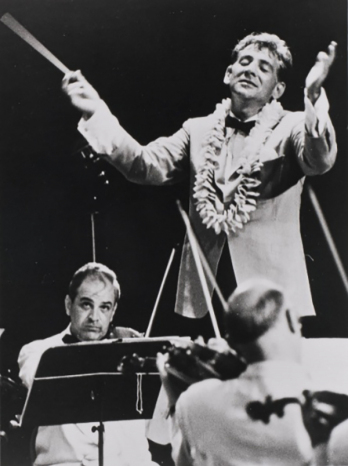
Photo: Leonard Bernstein conducts the New York Philharmonic at Waikiki Shell in Hawaii, August 1960.
--
All photos courtesy of the New York Philharmonic Shelby White & Leon Levy Digital Archives.
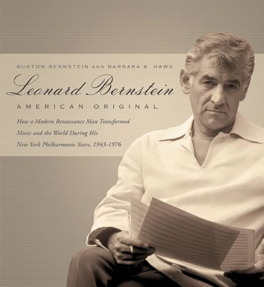
Reprinted by permission from Leonard Bernstein: American Original, edited by Burton Bernstein and Barbara Haws. Copyright © 2008. All rights reserved. Available through Harper Collins.