Latest News
Artful Learning: Connect + Reflect
Posted June 16, 2026
Background
At the heart of Artful Learning is a concept-based, interdisciplinary framework built around a universal Concept and a guiding Significant Question that encourage deep exploration across subject areas. Students move through four phases of learning—Experience, Inquire, Create, and Reflect. They begin by engaging with a Masterwork that sparks curiosity and connection to the Concept, investigate ideas through inquiry and research, express their understanding through an Original Creation, and conclude by reflecting on their learning process and discoveries. Together, these elements help students make meaningful connections, think critically, and develop a lifelong love of learning.
CONNECT + REFLECT
by Beth McCoy
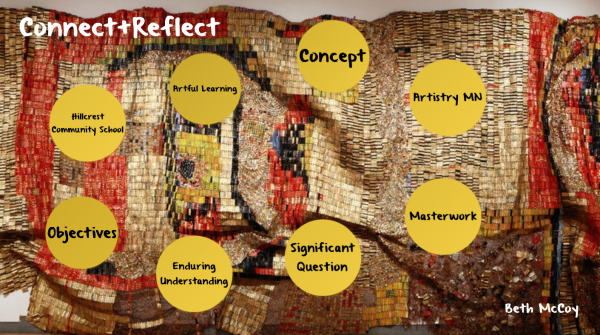
In 2021, the first anniversary of COVID arrived quietly in our school, where masks, distance, and the lingering effects of isolation were still part of daily life. Yet in one extraordinary week, artists entered classrooms and transformed the building into a shared space of creation, reflection, and hope, showcasing how arts integration can foster community healing and resilience.
The Connect + Reflect project—a school-wide exploration of the concept of Adaptation culminating in a community Original Creation—answered our community's deep need to pause and acknowledge all that students, families, and staff had endured together. We knew the Artful Learning framework would be our structure to build upon.
Our students had been shifting between distance learning, hybrid schedules, and full in-person classes, with some remaining online. These frequent changes demanded resilience and flexibility from students, families, and staff, often leaving them feeling disconnected and exhausted.
The Connect + Reflect Residency emerged as a way to bring people back together—not only physically within the school walls, but emotionally as a community. It offered students and staff an opportunity to recognize that even in a season defined by distance, we had endured it side by side.
“When faced with adversity, how can the arts help us connect, communicate, and heal?” This was the Significant Question that framed our inquiry and launched our learning.
The concept of Adaptation is universal, woven through challenge, loss, resilience, and transformation. Ghanaian artist El Anatsui’s extraordinary wall sculpture, Many Came Back, exemplifies this concept beautifully; it was presented to students as a masterwork expressing the power of Adaptation. Even the title felt hopeful, echoing the journey our own school community had experienced. During the Inquiry phase, students learned about Anatsui’s life, artistic practice, and creative process, examining how he transforms discarded materials into powerful works of art that speak to renewal, perseverance, and change.
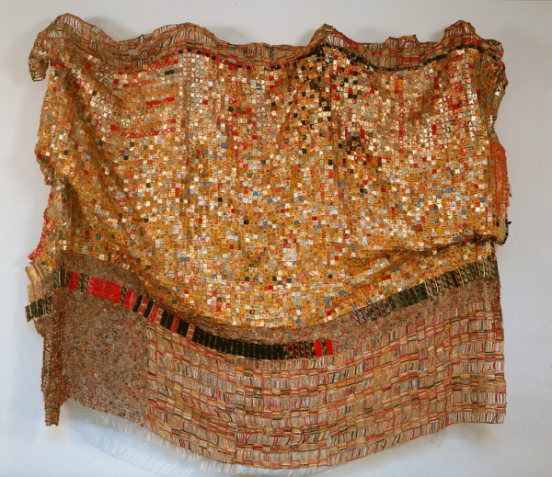
Photo: El Anatsui, Many Came Back, 2005
At first glance, Anatsui's tapestry appears soft and seamless, glowing in gold, copper, red, black, and silver. But up close, students discovered it was made from thousands of discarded metal fragments—bottle caps, aluminum seals, and scraps—woven together with delicate copper wire, transforming the broken pieces into something breathtakingly whole and beautiful. Like the tapestry, we had been stretched, reshaped, and disconnected. Yet through care, creativity, and connection, students and staff found ways to hold one another together.
The first step in the residency was simply listening. Through virtual classroom visits, artists invited students into thoughtful conversations about their experiences during COVID. Students spoke candidly about their fears, losses, challenges, and hopes, revealing both the hardships they had faced and the resilience they had discovered. These heartfelt reflections were transformed into grade-level poetry that captured the collective voice of children navigating an unprecedented moment in history. Together, these shared experiences and the poetry they inspired became the foundation for the Original Creation.
The following week, weaving artists joined classrooms via Google Meet for a week-long residency focused on creating deeply personal COVID weavings, which would be combined to create a community Original Creation. Students gathered artifacts from home that symbolized their experiences during the pandemic. The materials they brought were both ordinary and profound: clothing fabric, computer cords, masks, belts, shoelaces, flags, cereal boxes, and other found objects woven into the fabric of quarantine life.
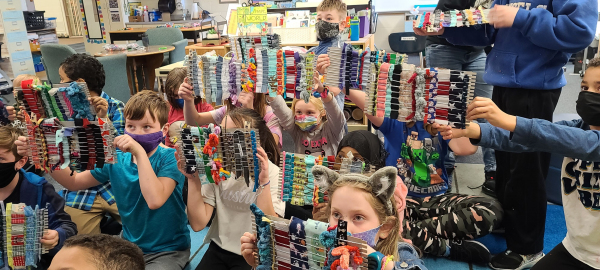
As students worked, they raised their weavings to computer cameras to receive feedback and encouragement from artists in real time. Students learning remotely were equally included through weaving kits delivered to their homes. Together, students learning both in person and online created side by side, connected through screens, shared experiences, and artistic expression.
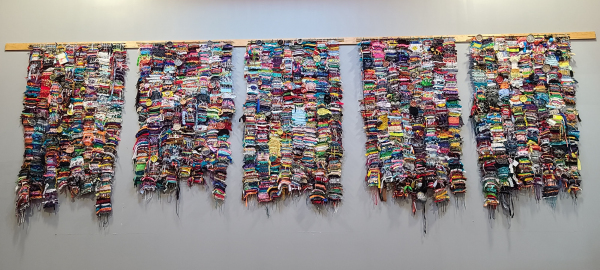
Fifth-grade students extended the project by sculpting clay buttons that were attached to the tops of the weavings. While the buttons provided a practical means of securing and displaying the individual pieces, they also carried a powerful metaphoric meaning. As the oldest students in the building, the fifth graders represented steadiness, leadership, and support within the school community. Just as the buttons held the weavings together, these students helped hold the school community together through their encouragement and resilience.
To deepen the project's emotional impact, Hillcrest music teacher Scyler Scherer guided students in creating an auditory soundscape. Students thoughtfully selected instruments whose tones and textures best reflected their emotions during the pandemic, using sound to express feelings that were often difficult to put into words. Some chose instruments that conveyed uncertainty, isolation, or loss, while others gravitated toward sounds that suggested hope, resilience, and connection. Classroom teachers also contributed twelve "beats"—each intended to capture the emotional rhythm of COVID’s first year. When combined, these individual contributions formed a powerful collective composition that echoed the experiences represented in the weavings, allowing viewers not only to see the community's story but also to hear it.
The recordings were layered into a hauntingly beautiful auditory tapestry—a soundscape of uncertainty, resilience, isolation, connection, and hope. The music surrounded the artwork, transforming the installation space into a collective memory of a moment that profoundly shaped an entire school community.
The unveiling of the Connect + Reflect tapestry was thrilling to behold. As students entered the space, they were immediately surrounded by the gentle sounds of the auditory soundscape, creating an atmosphere that felt both sacred and deeply personal.
Then came the moment they recognized themselves within it.
As students drew close enough to see the individual weavings in the massive tapestry, audible gasps filled the space. Hands instinctively shot into the air, fingers pointing excitedly toward their own pieces, their classmates’ work, and the countless stories now connected. What had once been individual experiences of isolation, uncertainty, and adaptation had become something collective—something beautiful.
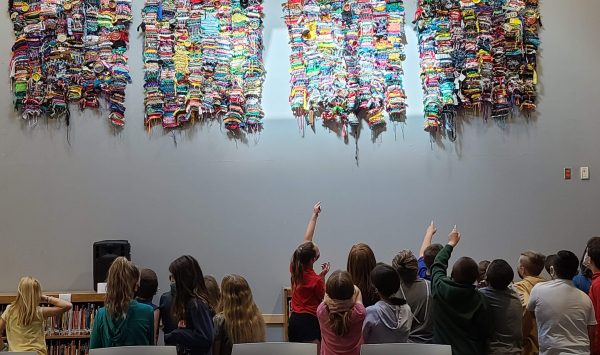
Laughter, awe, and pride rippled through the crowd as students stood beneath this extraordinary visual response to a shared chapter in history. At that moment, the Artful Learning model became fully realized. We had inquired into our shared experience, reflected on its meaning, and created something that honored not only what we had endured, but how we had found our way back to one another.
Tapestry Soundscape & Video ReCap produced by the City of Bloomington:
--
Beth McCoy is an Artful Learning Master Trainer and educator at Hillcrest Community School in Bloomington, MN.