Latest News
Three Notes to Somewhere
Posted June 16, 2026
Three Notes to Somewhere
by Lara Downes
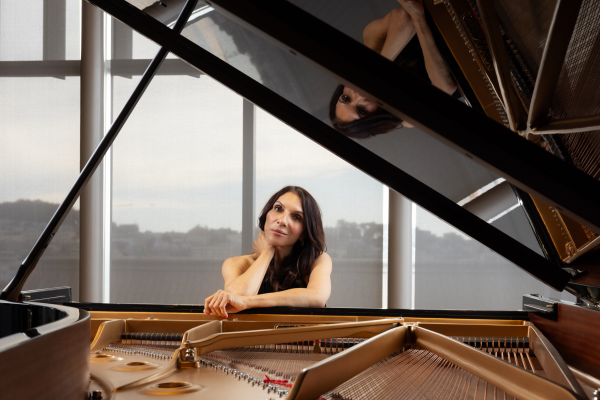
In 2018, I made an album called For Lenny, celebrating the centennial of Leonard Bernstein’s birth. The record is a tribute to Bernstein the man - the father, the teacher, the friend, the optimist and activist and citizen deeply committed to engaging with the realities of his world and his time. That project brought me into Bernstein’s world, into his family, and into a determination to live my artistic life with that profoundly human, civic commitment as a guide.
My relationship with Bernstein’s music started early, way back when I was 7 years old, in my Saturday morning theory and ear training class at the San Francisco Conservatory of Music. Our teacher was a sweet young guy, with dark, curly hair and a beard. I think possibly he was my first crush. The moment is crystal clear in my memory: he sat down at the piano and played the opening notes of Leonard Bernstein’s song Somewhere from West Side Story, then turned to the class and said: “Now you’ll always recognize a minor seventh when you hear one.” And I always have.
Those first three notes - haunting, achingly beautiful, unforgettable. “There’s a…” The minor-seventh interval rises, searching and questioning, before resolving downward on “place.” It’s a musical sigh, the sound of longing curving into hope. A perfect phrase that takes your hand and leads you toward peace and quiet and open air.
Soon after that Saturday morning, I fell deeply, madly in love with West Side Story. I can’t begin to count the number of times I watched the movie, enthralled by its sweeping tale of star-crossed young love and by the magic of Bernstein’s music and Sondheim’s words. A perfect score full of perfect songs, from the white-hot fire of America to the acrobatic wit of Gee, Office Krupke and the aching devotion of Maria. But it’s Somewhere that became an anthem for me, as it has for so many - a timeless expression of our yearning for this world to be a better place, and our stubborn belief that somewhere beyond violence, division and disappointment, we can make it so.
Years later, when I moved to New York City, I started hearing those same three notes somewhere unexpected: underground. If you ride the subway, you know the sound. As the train pulls out of the station, an interaction between electric current and steel rails produces a startlingly familiar melody: an ascending minor seventh followed by a descending half-step. “There’s a place…”
The parallel, it turns out, is pure coincidence. Jamie Bernstein told me the subway didn’t even make that sound back in 1956, when her father wrote West Side Story. Physics, not inspiration, is responsible. Still, the coincidence feels strangely poetic. The promise of transcendence echoing through one of the least transcendent environments imaginable. A dream of peace and quiet and open air reverberating through the airless, subterranean tunnels of this hectic, noisy city.
West Side Story is very much a product of its time - the anxious, combustible America of the mid-1950s. The choice to set its Romeo and Juliet-redux plot about teenage street gangs on the west side of Manhattan was inspired by the racial tensions then playing out in the San Juan Hill neighborhood, as its ethnically mixed, largely immigrant population was displaced to make way for the construction of what would become Lincoln Center for the Performing Arts. New York City was changing fast, as was the nation, floating at the height of its post-war boom, but at the same time shaking with the vibrations of powerful cultural shifts. 1956 was the year of the Montgomery bus boycott, launching the civil rights movement with a first courageous act of organized protest. That year, Arthur Miller and Paul Robeson were called before the House Un-American Activities Committee as the communist witchhunt intensified. 60 million Americans watched, transfixed and/or scandalized, as Elvis Presley’s unfiltered sexuality beamed into their living rooms from the set of the Ed Sullivan Show. And Americans hit the road as never before when President Eisenhower’s creation of the Interstate Highway System opened up new possibilities of mobility and migration.
By the time West Side Story moved from Broadway to the big screen five years later, mid-century tensions and upheavals had escalated. The Freedom Riders were risking their lives traveling through the Deep South in protest against racial violence and segregation. Bob Dylan had just found his way from Duluth to Greenwich Village. John F. Kennedy, newly inaugurated as our 35th President, stated his intent to "draw a line in the sand" preventing a communist victory in Vietnam. And the FBI had compiled most of an 800-page dossier documenting the agency’s decades-long surveillance of Leonard Bernstein.
I have been obsessed lately with the question of how art reflects life. It’s inevitable, on one hand. Creativity does not exist in a vacuum; it’s informed by its world and its time. But when the world is especially troubled, when the times are inordinately hard, how does art respond? Bernstein famously had an answer: "This will be our reply to violence: to make music more intensely, more beautifully, more devotedly than ever before." He delivered those words in November 1963, just after JFK’s assassination - a powerful statement to a nation in mourning from an artist who never stopped trying to make the world a better place.
I found myself offering a similar thought just a few weeks ago, during a visit to a middle school classroom in Canarsie, teaching a workshop about American music and social progress. “The thing about music is that it allows people to imagine change.” I said to the students. “And you have to imagine change before you can make change.”
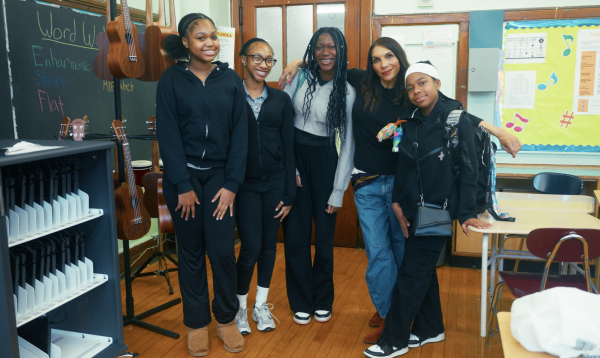
Listen to Somewhere and you cannot help but imagine change - a better place where we can find a new way of living and forgiving, a place so desperately needed as the world swirls with constant storms of tragedy and violence. And in imagining such a place, maybe we can be inspired to create it. To do what we can, in small acts of civic kindness and generosity. To give up a seat on the subway, help a mother carry her stroller up the stairs. To have patience with our fellow riders in a crowded train car at the end of a long day. Simply to care for each other and believe in each other, despite all the global evidence that can so damage our trust and our love.
On July 1, I’ll gather together some great American musicians on the stage of Lincoln Center, to celebrate the role of our music as the voice of its people and the sound of its time. The concert, called Declaration: Songs of Democracy, Voices of Hope, will offer our musical perspectives on the 250 years of our history, on our present and our future. And in this time of so much conflict and chaos, distrust and disillusionment, we’ll dare to imagine something better as we close the concert with Leonard Bernstein’s perfect song, our voices tracing the fragile arc of a minor seventh to lean into the promise of “a place for us, somewhere.”
DECLARATION: Songs of Democracy, Voices of Hope
Wednesday July 1, 2026 at 7:30pm - David Geffen Hall
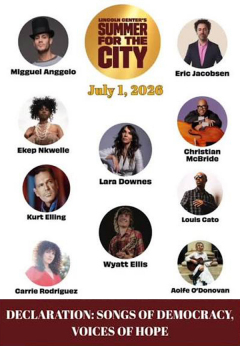
What does it mean to be an American today? That is the question posed by curator, pianist, and producer Lara Downes in Declaration: Songs of Democracy, Voices of Hope, featuring world premieres by three major composers. Valerie Coleman presents Life, a work for solo piano; Arturo O'Farrill offers Liberty; and Christopher Tin closes with The Pursuit of Happiness. These latter two compositions are performed by the American Composers Orchestra, under the baton of Eric Jacobsen. In addition, Downes has gathered a select collective of artists performing iconic, beloved songs that represent the fullness of the American experience. Her guests include renowned vocalists Kurt Elling, Ekep Nwelle, and Aoife O’Donovan; jazz bassist Christian McBride; versatile singer/songwriter Carrie Rodriguez; breakout bluegrass star Wyatt Ellis; cabaret powerhouse Migguel Anggelo; Late Show bandleader Louis Cato; Tuskegee University’s historic Golden Voices Concert Choir, and more! Featuring Terrance McKnight of WQXR, New York's Classical Music Radio Station.
Before and after the show, stop by the Hauser Digital Wall in the David Geffen Hall lobby for a display of video portraits captured during Downes' travels across America with The Declaration Project.